Functions in Python
You already know several functions in python, such as print(), range(), len(). Behind these words stand a block of code
which will only be executed when you call the function. Let’s look at the example of the function len(). When you
want to find out the length of a data structure, i.e. how many characters there are in a string, you can use the following
statement:
l = [1, 2, 3, 4, 5]
print(len(l))

# Output: 5
When using a function, you pass data, known as parameters, in this case you use the variable l, into the function.
Python then runs the function and returns the results. You can find more detail about the len() function here:
https://www.w3schools.com/python/ref_func_len.asp
Why do we use or define functions? It’s an abstraction method to enable re-usage of code again.
To return a value use the return keyword. You can return any value from a function.
If you do not specify a return value, the default will be None.
# Defining functions
def add2(a, b):
    result = a + b
    return result

def add3(a, b, c):
    return a + b + c

s1 = add2(3, 4)
s2 = add3(3, 4, 5)

print(f"The sum is: {s1}")
print(f"The sum is: {s2}")

# How to implement this if we don't know how many values will be added:

def add_any(values): # Use a list
    result = 0
    for v in values:
        result = result + v
    return result

s3 = add_any([1, 1, 2, 2, 3, 3])
s4 = add_any([])

print(f"The sum is: {s3}")
Ask for user input
The input given is automatically saved as a string. However if you want to do any mathematical calculation with this input, you either need to convert it into a float or an integer. Why is it useful to ask the user for input? For instance, you could ask the user for the name of the file the user whats to load. Or you could ask the user for input on the size of a sliding window for calculation of the average. Or ask the user for input on which range of the data to plot.
# Ask the user for input
name = input("What is your name? ")
print(f"Hello {name}")

number1 = input("Give me a number: ")
number2 = int(number1) # Convert it to an integer
number3 = float(number1) # Convert it to a float
import numpy as np
# Ask for a file name to load:
filename = input("Which file do you want to open? ")
data = np.loadtxt(filename)
Attention
Exercise 3.2:
Now write a function that reads in numbers from the user and calculates the total sum and prints this value at each iteration. The program should also print out all the numbers sorted (ascending) at the end. In order to quit the program the user has to enter quit instead of a number.
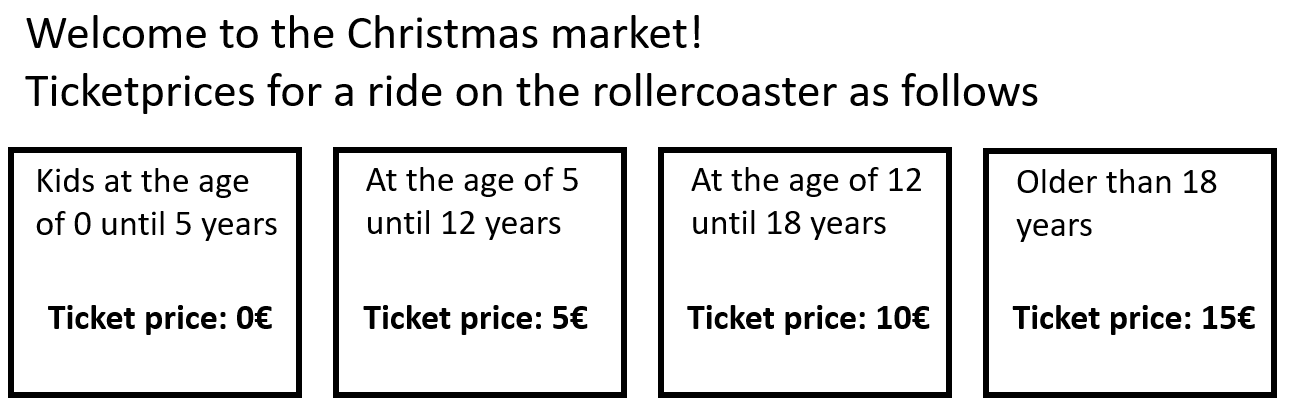
Rollercoaster on the Christmas Market in Tübingen
Attention
Exercise 3.3:
Ultimate goal of this exercise is that your write a code that calculates how much a group of people pay to take a ride on the rollercoaster. To save you from calculating it for every individual and summing that up, you should use what you learned about loops and lists and write a code. This exercise should be solved in two stages. First write a code that asks the user for age of a person. Using this input your code needs to print out how much that person has to pay to ride on the rollercoaster. In the next stage create a list of 20 randomly chosen ages and change your code so it calculates the sum of all the ticket prices that group of 20 people would pay to ride on the rollercoaster.